The Kalevala, the great book of old Finnish songs, tells of the most wonderful thing ever made.
It begins with Väinämöinen, the old and wise singer, stranded far from home in Pohjola, the cold land of the north. Louhi, the mistress of Pohjola, offered to send him home on one condition: someone must forge her a Sampo. Nobody was quite sure what a Sampo was. But Väinämöinen knew someone who could make anything.
“My friend Ilmarinen will make it,” he promised, and hurried home before anyone could ask for details.
Ilmarinen the smith was not delighted to hear this. Still, he travelled north, built a forge and gathered the strangest ingredients: the tip of a swan’s feather, a drop of milk from a cow that gave none, a single grain of barley and a tuft of wool from a summer sheep.
He put them into the fire and worked the bellows for three days. The first thing to rise from the flames was a crossbow, beautiful but bad-tempered, which wanted a fight every day. Ilmarinen broke it and threw it back. Next came a boat that wanted to sail off to war, then a cow that kicked over every milk pail, then a plough that ploughed up the neighbours’ fields. Back into the fire, every one.
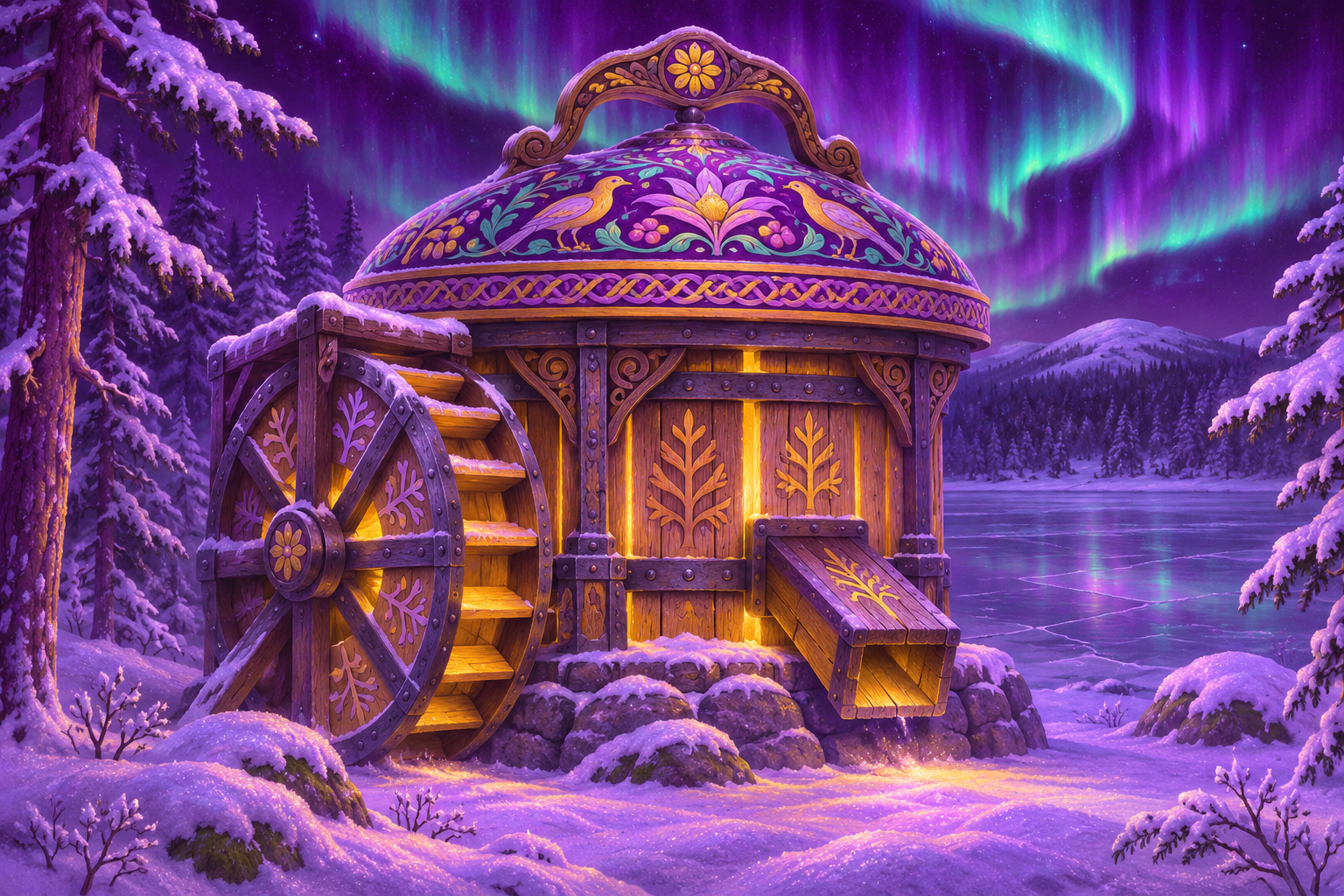
At last he called the winds to work the bellows for him. They blew for three more days, from the east and the west, the north and the south. And when Ilmarinen looked into the forge, there was the Sampo, its lid as bright and many-coloured as the northern lights.
On one side it ground flour, on another salt, and on the third everything else a home could need, a whole binful every morning.
Louhi was overjoyed. She locked the Sampo inside a stone hill behind nine locks, where it put down roots nine fathoms deep, and Pohjola never went hungry again.
Years later, Väinämöinen, Ilmarinen and the cheerful, reckless Lemminkäinen sailed north to bring the Sampo home. Väinämöinen played his kantele so sweetly that all of Pohjola fell asleep, and the three heroes dug up the Sampo and rowed away.
All would have been well if Lemminkäinen could have kept quiet. But he was so pleased that he began to sing, very loudly, and woke a crane, and the crane woke Louhi. She turned herself into a giant eagle and chased them across the sea. In the struggle, the Sampo slipped from the boat and broke into a thousand pieces.
The largest pieces sank to the bottom, and that, people say, is why the sea is so full of fish. The smaller ones washed up on the shores of Finland, and wherever they landed, the barley grew thick and the fields were good.
The old singers of the Kalevala kept every one of these songs, called runes, in their heads, word for word. If you would like to find out how good your own memory is, Rune Memory is waiting.